
How to Spot Bot Dating Profiles - Warning Signs and Safety Checks
Learn how to spot bot dating profiles early, verify identity safely, and avoid scam behavior before it wastes your time, money, or emotional energy.
Bot dating profiles have become more convincing, which is why basic safety habits matter more than ever. Some bots are built to push you off-app fast. Some are designed to warm you up emotionally before a scam pitch. Others are simply engagement farms collecting clicks and data. The difficult part is that many do not look obviously fake at first glance — and the tactics evolve constantly. The right strategy is not paranoia. It is pattern recognition. One weak signal may mean nothing. Several weak signals together usually mean something important. The FTC has documented how bot-driven scam networks operate at scale, and the patterns in this guide are drawn from those real-world reports. You will learn what bot-driven profiles often do, how to verify without sounding aggressive, and when to stop engaging before the risk gets expensive.
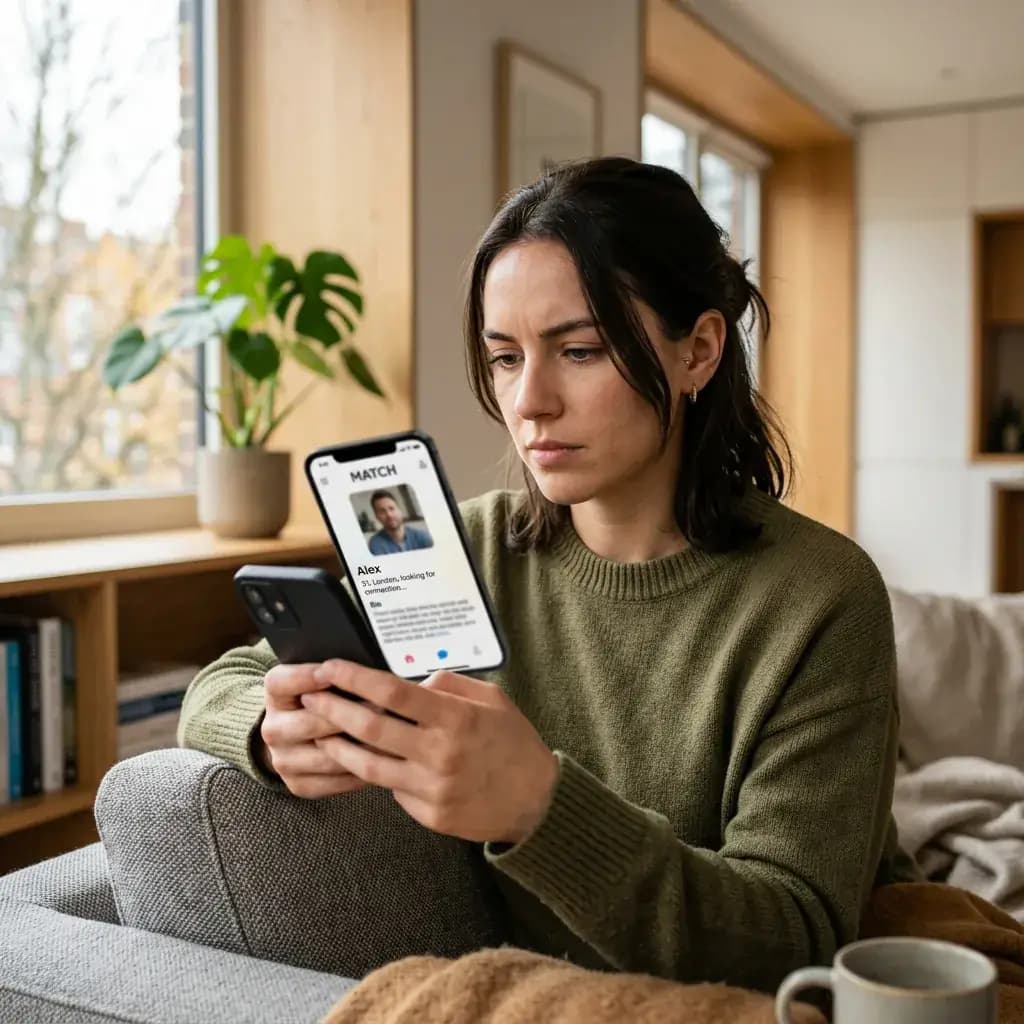
Warning Signs to Watch For
⚠️ Only one or two polished photos
A thin photo set does not prove a profile is fake, but it lowers your confidence immediately. Real users usually have a mix of casual photos, angles, outfits, and contexts. Fake profiles often rely on one or two unusually polished shots because they are using stolen or carefully selected images. When every photo looks like it belongs in a professional portfolio and there is no ordinary, everyday image to balance it out, verification becomes much more important.
⚠️ The bio says almost nothing real
Generic bios like 'just ask,' 'living my best life,' or 'here for good vibes' are common on real profiles too, but they become suspicious when paired with weak photos and evasive behavior. Scammers and catfish often want the broadest possible appeal, so they keep bios vague. A real person may write a lazy bio, but over time they can usually add detail in conversation. A fake profile often stays generic no matter how specific your questions become.
⚠️ They want to move off-app immediately
One of the clearest scam patterns is urgency around switching to WhatsApp, Telegram, Signal, or text before trust has been built. Dating apps have reporting, moderation, and blocking tools. Fake accounts often want to leave that environment quickly. A real user may eventually prefer another platform, but someone who pushes for it right away, especially before any meaningful conversation, is telling you that speed matters more to them than comfort or safety.
⚠️ Their story changes in small but important ways
Many fake profiles fail because they cannot keep their story internally consistent. It might be age, job, travel history, or family details. The inconsistencies are often subtle at first, which is why they get missed. Pay attention when the person repeats facts differently or gives vague answers to basic questions that most real people answer naturally. Consistency is one of the easiest authenticity signals to check over a few days of conversation.
⚠️ They avoid video calls or current proof
A short video call or current selfie is one of the simplest verification tools available. If someone repeatedly avoids it with a fresh excuse every time, take that seriously. Being busy once is normal. Having a broken camera, bad connection, travel emergency, and sudden schedule conflict every single time is not. Verification avoidance is one of the strongest catfish indicators because it protects the core deception.
⚠️ The emotional pace becomes intense too quickly
Fake profiles often use accelerated intimacy to create trust before logic catches up. If someone is calling you special, rare, or deeply understood after only a few exchanges, be careful. Love-bombing can appear flattering, especially if the conversation has been smooth. But healthy connection has a pace. Extreme emotional intensity before real knowledge and verification is often a tactic, not chemistry.
⚠️ Money, investment talk, or crisis requests appear
Any request involving money should be treated as a major red flag, whether it arrives directly or through a dramatic story. Romance scammers often build trust first and then introduce a crisis, investment pitch, gift-card request, or travel problem. The exact script changes, but the pattern is the same: emotional pressure plus financial ask. For a deeper breakdown of how this escalation works, see our romance scam warning signs guide. If money enters the conversation before you have met safely and verified identity, stop engaging.
⚠️ Your instincts stay uneasy even when the details seem plausible
Sometimes the red flag is not one sentence or photo. It is the feeling that the profile is always one step away from being concrete. The photos are good, but too good. The conversation is warm, but strangely repetitive. The person answers, but never in a grounded way. Your intuition is often picking up on a pattern your conscious mind has not fully named yet. That does not mean panic. It does mean slow down and verify before investing more.
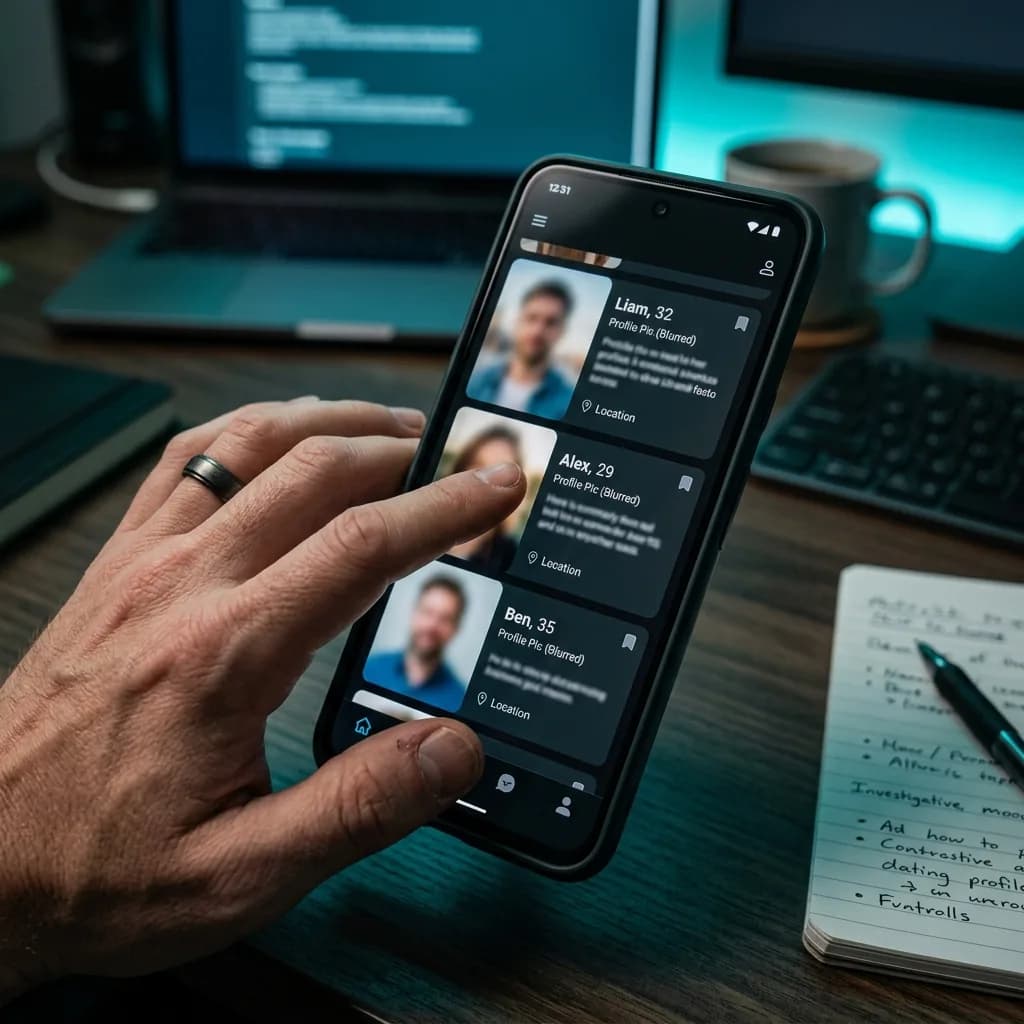
How to Protect Yourself
💡 Run a reverse-image search when the photos feel too perfect
Reverse-image search is not foolproof, but it is one of the fastest ways to catch stolen photos. If an image appears on unrelated social accounts, stock sites, or modeling pages, you have useful information immediately. You do not need to do this on every profile. Save it for the ones that feel too polished, too generic, or too inconsistent with the rest of the story.
💡 Ask specific, ordinary questions
Fake accounts usually struggle more with ordinary specifics than dramatic ones. Ask about a routine, a neighborhood, a recent meal, or why they like a hobby they mentioned. Real people tend to answer with natural context. Fake profiles often answer broadly because they are trying not to get trapped in details they cannot sustain later.
💡 Use one verification step before emotional investment
You do not need a full investigation, but you should have at least one reliable verification point before the conversation becomes emotionally important. That can be a short video call, a live selfie, or an in-person meeting in a public place. The key is to verify earlier, not after you already feel attached to the story.
💡 Do not rush off-platform if you do not want to
You are allowed to stay on the dating app until you feel comfortable. If someone pushes back against that boundary, that reaction is meaningful. Healthy people understand that safety takes time. Someone who treats your caution like an inconvenience is showing you that your comfort is not their priority.
💡 Tell a friend before meeting anyone new
Even if the profile seems genuine, basic safety routines matter. Share the meeting place, time, and person with a friend. Keep your first meeting public. Use your own transportation when possible. Fake-profile awareness is not only about online deception. It is also about reducing risk if something feels wrong later.
💡 Use a checker tool as a second opinion, not a final verdict
Safety tools like our fake profile checker can help you notice patterns you might otherwise ignore, especially when attraction is making you rationalize. They work best as a second opinion. Use them to organize your thinking, not to override your common sense. If the tool says low risk but your instincts say something is off, trust the instinct and verify anyway.
Frequently Asked Questions
Related Guides
Online Dating Safety
Explore related guides and tools to help you navigate this topic.

Get weekly bio ideas, openers, and dating templates
Join thousands of people improving their dating game with free weekly tips. No spam, unsubscribe anytime.
No spam. Free tips only. Unsubscribe anytime.
By subscribing, you agree to our Privacy Policy.
Use our safety tools
Check profiles and conversations for red flags with our free AI-powered safety tools.