

Why Most Dating Profiles Sound the Same
Open any dating app right now and scroll through ten profiles. You will probably see some version of the same handful of lines. Loves to travel. Looking for my partner in crime. Fluent in sarcasm. Work hard, play hard. These are not bad qualities — plenty of real, interesting people genuinely enjoy travel and value humor. The problem is that none of these lines tell you anything specific about the person behind the profile.
When everyone writes the same things, nobody stands out. And standing out is the entire point. A dating profile is not a resume. It is not a list of traits you hope someone will approve of. It is a short pitch that answers one question: what would it feel like to spend time with you? The profiles that work best answer that question with details that are hard to copy because they belong to one specific person. That is not about being the funniest or the most attractive. It is about being legible — giving someone enough signal to decide whether your energy matches theirs.
The shift is smaller than you think. You do not need to rewrite your personality. You need to rewrite the way you communicate it. A few concrete changes — replacing vague claims with specific habits, cutting filler lines, and adding one clear conversation hook — can move your profile from invisible to interesting without turning it into a performance.
The Three-Part Structure That Works on Every App
Strong dating profiles tend to follow a loose three-part structure, whether the writer planned it that way or not. The first part reveals a specific interest or habit. The second part gives a read on personality or energy. The third part offers a conversation hook — something easy to respond to.
Here is how that plays out:
1. A specific detail about how you spend your time. Not a category like cooking or fitness but an actual habit. Instead of writing that you love food, try something like: I have been trying to perfect a shakshuka recipe for three months and I am getting dangerously close. Instead of saying you work out, try: Morning runner, but only the kind who looks miserable for the first mile and slightly less miserable for the rest.
2. A personality signal. This is where you show how you move through the world. Quiet and observant? Say so. Warm and talkative? Show it. The key is honesty without apology. Lines like better at choosing restaurants than starting small talk or the friend who always remembers the thing you mentioned once both say something real about a person without overselling.
3. A low-friction conversation hook. This gives the other person an easy way in. A question works. A mild challenge works. An invitation works. Tell me the last meal that genuinely impressed you or currently accepting recommendations for underrated weekend activities are both easy to respond to. The goal is not to be clever. It is to lower the barrier.
This structure works on Tinder, Bumble, Hinge, and basically any platform where profiles matter. The format may change — Hinge uses prompts, Bumble has a character limit — but the principle is the same. Give someone a reason to stop scrolling.
What to Include and What to Leave Out
A good dating profile is as much about what you leave out as what you put in. There is a common instinct to cover everything — your job, your hobbies, your values, your deal-breakers, your love language — and turn a bio into a compressed autobiography. That instinct usually backfires because it leaves nothing to discover.
Include things that are specific to you and hard for someone else to claim. A line like I collect vintage cookbooks and actually cook from them does more work than I love cooking because it creates a visual, raises a question, and suggests something about your personality in one sentence.
Include one honest personality marker. Something that tells a reader what your energy is like. Are you the person who plans the trip or the one who shows up and goes along? Are you the loud one at the table or the one asking the good questions? These signals matter because they help people self-select. The right match will see themselves in your description. The wrong match will scroll past, and that is actually the system working correctly.
Leave out requirements lists. Lines like must love dogs, no drama, and looking for someone who has their life together rarely attract the people they are aimed at. They read as demands before a single conversation has happened. The early stages of dating should feel inviting, not like a job posting.
Leave out self-deprecation that goes too far. A single self-aware joke is fine. I am probably too invested in finding the best ramen in this city is charming. I am bad at everything and do not know why I am on here is not. There is a line between warmth and pity, and strong profiles stay on the warm side.
Leave out clichés you did not earn. If your idea of adventure is a Saturday farmers market, do not call yourself adventurous. Call yourself a farmers market loyalist. That is more honest and more interesting.
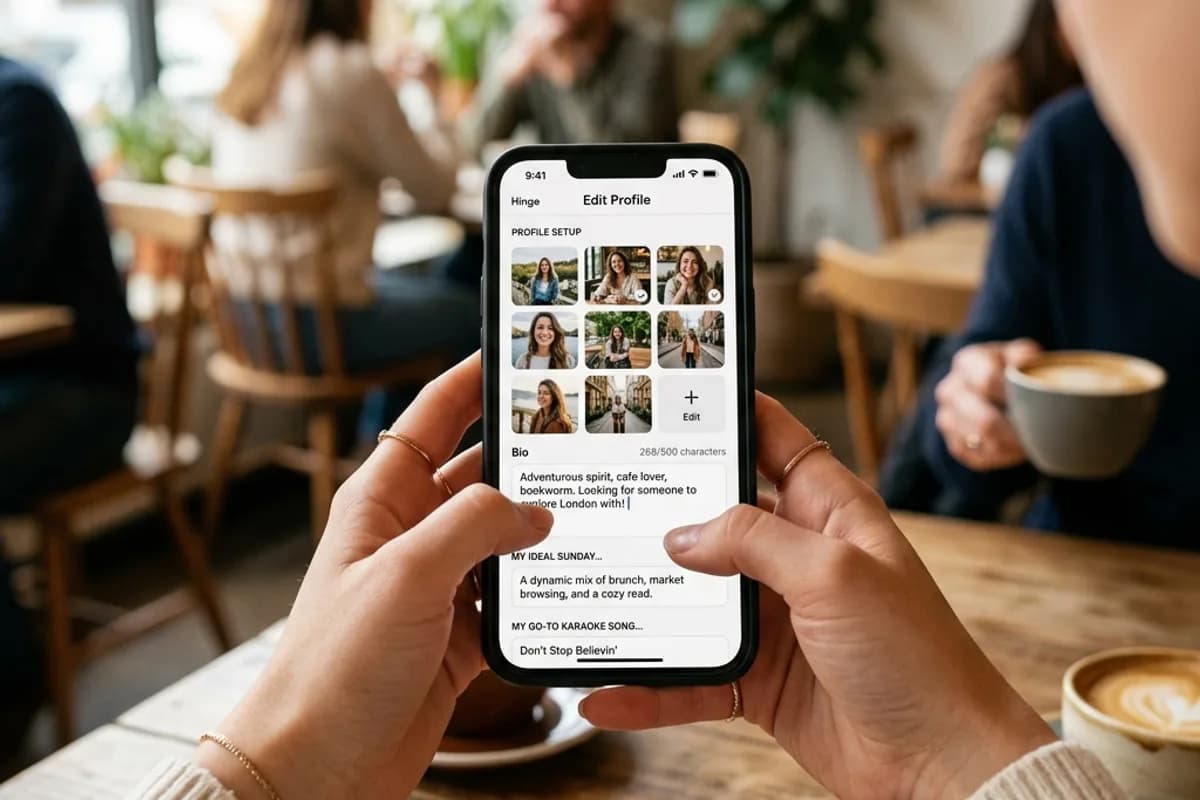
Real Profile Examples That Work and Why
These are not templates to copy directly. They are patterns to learn from. Notice how each one creates a picture and leaves room for a reply.
Example 1: Morning coffee is non-negotiable. I make a strong pour-over and judge every cafe by whether theirs is better than mine. Weekends are usually long walks, something cooking on the stove, and a book I will pretend I finished. Quiet at first, but I warm up with the right person.
Why it works: It is specific, shows routine, gives a personality read (introverted but warm), and has natural conversation hooks — coffee preferences, what book they are reading, cooking.
Example 2: I plan the best spontaneous-seeming dates. The kind where it looks effortless but I have actually checked three review sites and confirmed there is good parking. Ask me where to eat and I will give you a list organized by neighborhood.
Why it works: It shows a real personality trait (thoughtful planner who presents casually), it is funny without trying too hard, and the last line is a direct invitation to engage.
Example 3: Software engineer by day. The rest of the time I am building a suspicious number of playlists, exploring the neighborhood, and texting my friends more food photos than they asked for. Looking for someone who can hold a conversation and suggest something I have not tried.
Why it works: It mentions work without making it the whole identity. The hobbies are specific and visual. The closing line sets a standard without sounding demanding.
Example 4: Two things I care about more than I should: finding the perfect window seat in a cafe and arranging my bookshelf in a way that makes sense to exactly one person — me. If you have strong opinions about either of those, we should probably talk.
Why it works: Quirky without being random. The details create a strong visual. The closing line is inviting and low-pressure.
The pattern across all of these: specificity, personality, invitation. Every strong bio hits those three things in its own way.
Common Mistakes That Kill an Otherwise Good Profile
Some profiles have the right raw material but bury it under avoidable mistakes. Here are the most common ones.
Starting with a negative. Do not open with what you do not want. No hookups, not here for games, and tired of fake people may all be valid feelings, but leading with them creates a defensive first impression. Your bio is an introduction, not a boundary-setting exercise. Save screening for conversation.
Using empty superlatives. Saying you are the funniest person someone will ever meet or the most loyal partner is a claim that cannot be verified from a profile. It reads as overcompensation. Let your actual words demonstrate the quality instead of announcing it.
Being vague about everything. A profile that says I love life, good vibes, and meeting new people has technically said something, but it communicates nothing. Every line should pass the could-someone-else-say-this-word-for-word test. If the answer is yes, replace it with something only you would write.
Writing a wall of text. Even great content needs breathing room. Two to four short paragraphs or a few clean lines with natural breaks is usually the right length. People scan profiles — especially on mobile — and dense paragraphs get skipped.
Forgetting the hook. A profile that describes you perfectly but gives the reader no way to respond is doing half the job. Always end with something someone can grab onto. A question, a challenge, a reference to something you mentioned earlier. The hook is what turns a profile view into a message.
How to Test and Improve Over Time
The best dating profiles are rarely the first draft. They evolve through testing, small adjustments, and honest self-assessment.
Start by writing three versions of your bio. Not three slightly different copies — three genuinely different approaches. One might lead with humor, one with warmth, one with a specific story. Use the one that feels most like you when you read it back out loud. If it sounds like something you would say to a friend, it is probably close to right.
Then pay attention to results. Not just match count, but message quality. Are people responding to the hook you planted? Are they referencing something specific from your bio? If so, the profile is doing its job. If conversations still feel random and generic, your profile may still be too vague.
Ask a trusted friend to read your bio and tell you what impression it gives them. Not whether they like it — whether it sounds like you. The gap between how you see yourself and how your profile reads is often wider than you think. A second perspective closes that gap faster than any rewrite.
Change one thing at a time. Swap a weak opening line for a stronger one. Test a new hook. Remove a line that felt clever when you wrote it but might not land. Small iterations are more useful than complete rewrites because they help you isolate what actually moved the needle.
Finally, revisit your profile every few weeks. Your life changes. Your interests shift. Your sense of what you are looking for becomes clearer. A profile that is three months old may not represent who you are today. The goal is not to write the perfect bio once. It is to keep it honest, current, and clear enough that the right person can find you.