

Why the First Message on Bumble Matters More Than You Think
Bumble puts the opening message in the hands of women, and that changes the dynamic in a way most people underestimate. On other apps, men send the first message and women filter. On Bumble, you set the tone. That is both an advantage and a responsibility, because a weak opener creates the same problem from the other direction — the conversation dies before it starts.
The issue is not that opening a conversation is hard. The issue is that most openers are so generic they give the other person nothing to work with. Hey, hi there, and how is your day going are technically messages, but they transfer all the creative effort onto the other person. And when someone gets a dozen matches a week, a message that requires them to do all the thinking is easy to skip.
A strong first message on Bumble does three things. It shows you looked at their profile. It picks up on something specific. And it makes replying feel easy instead of effortful. That combination moves a conversation from polite small talk to actual connection faster than any pickup line ever could.
Profile-Based Openers That Feel Natural
The most reliable conversation starters come directly from the other person's profile. Not as a performance of attentiveness, but as a genuine reaction to something you noticed.
If their profile mentions a trip: That lake photo looks incredible. Was that a planned trip or a we are driving until we find something situation? This works because it references something real, adds a fun binary choice, and is easy to answer.
If their profile mentions cooking: I need to know — are you the kind of cook who follows recipes exactly, or the kind who sees a recipe as a loose suggestion? This works because it shows interest in a detail, creates a playful question, and invites them to reveal personality.
If their profile mentions a dog: Your dog looks like it has opinions. What is the most dramatic thing it has done this week? This works because pet owners love talking about their pets, the question is specific enough to prompt a real answer, and it injects humor without forcing a joke.
If their profile mentions music: I saw the concert photo — what is the best live show you have been to? I am always looking for proof that good live music still exists. This works because it starts with their content, asks something easy, and shares a bit about you.
The pattern: reference something specific, ask something easy and interesting, and make the question feel like a conversation rather than an interview.
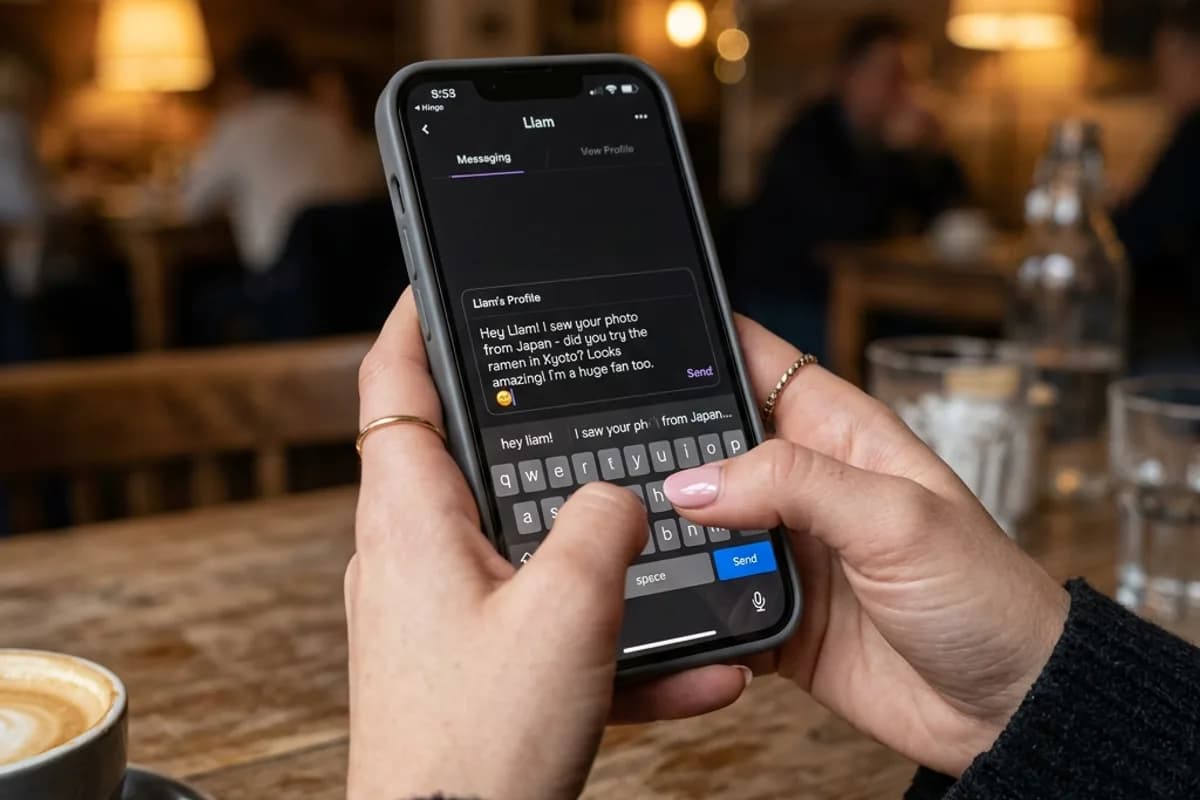
Openers for Profiles That Give You Almost Nothing
Not every profile is rich with detail. Some people are genuinely interesting but wrote a two-word bio and posted three photos with no context. You still matched with them for a reason, so the conversation is worth starting — you just need a different approach.
Option 1: Lead with a fun hypothetical. You are stuck on a road trip and you can only listen to one album the entire way. What are you picking? This works because it does not require profile knowledge, it is fun to answer, and the response tells you something real about the person.
Option 2: Start with a low-key observation. I will be honest, your profile is giving strong mystery energy. So let me start simple — what is something you are weirdly good at? This acknowledges the sparse profile without criticizing it and gives them a specific thing to respond to.
Option 3: Make a small bet. I am going to guess you are a coffee person based on absolutely nothing. Am I right or is this already going badly? This is light, playful, and invites an easy correction or confirmation.
The key with thin profiles is not to overthink it. A fun, specific, easy-to-answer question is worth more than a perfectly crafted opener. Most people do not expect brilliance in a first message. They expect something that does not feel lazy.
What to avoid: do not call out the empty profile in a negative way. Messages like you could have written more or your bio does not give me much to work with put the other person on the defensive immediately. You want to create warmth, not obligation.
The Openers That Almost Never Work
Some opening messages are so common that they have lost all impact. Knowing what to avoid is just as important as knowing what to say.
Hey or hi — This is the most common first message on Bumble, and it is also the most skipped. It communicates nothing and places the entire burden of conversation on the other person. Even adding one more sentence makes a noticeable difference.
You are cute or you are handsome — Complimenting appearance in the first message rarely leads anywhere interesting because it does not start a conversation. There is no natural follow-up to thank you that keeps things moving.
So tell me about yourself — This is too broad. It feels like a job interview and creates pressure instead of flow. Better to ask one specific, easy question than to hand someone an open-ended prompt with no direction.
Copy-pasted openers — If a message sounds like it could have been sent to anyone, it probably will be ignored like it was sent to everyone. Even a slightly personalized version of a standard question performs better than a perfect-sounding template.
Overly long first messages — A first message should not be a paragraph. Two to three sentences is ideal. Long messages can feel intense before a rapport exists, and they often overwhelm rather than impress.
The best openers share a quality: they feel like one person talking to another person, not like a script being delivered.
How to Keep the Conversation Going After the Opener
A good first message gets a reply. But the second and third messages are where most conversations either build momentum or stall. The transition from opener to actual conversation is a skill, and it comes down to three habits.
First, follow the thread. Whatever they responded with, build on it. If they told you about a concert, ask a follow-up. If they corrected your guess about coffee, ask what they drink instead. Following the thread shows genuine interest and keeps the exchange feeling natural.
Second, offer something about yourself. Conversation is not an interrogation. After asking a question, share something related. If you asked about their cooking and they answered, share your own kitchen disaster or favorite recipe. The back-and-forth should feel balanced.
Third, know when to move toward a plan. Bumble conversations that stay in the app too long tend to fade. Once the conversation has a rhythm and you are both engaged, suggest something low-pressure. A coffee, a walk, a specific restaurant. The shift from chatting to planning is where real connection starts.
The goal of a first message is not to impress someone with your wit. It is to create the conditions for a real conversation. If you can do that consistently — start with something specific, keep it balanced, and move toward meeting — the right people will respond.